
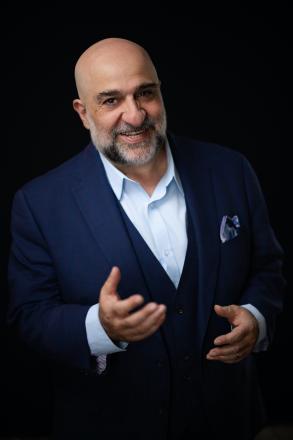
Ahead of the launch of his new four-part Radio 4 series, Namaste, on 10th September, we caught up with Omid to talk about the role comedy plays in an increasingly polarised world, people’s biggest misconceptions about him, and how he stays hopeful.
You describe the world as feeling louder, angrier and stranger than ever. Do you think we're actually more divided today, or just hearing more disagreement?
It’s hard to say. Much of what we see online is AI. So many posts are created specifically to make discourse more polarised. But thankfully comedy is one of the last bastions of truth. Comedians by and large wish to only either entertain, inform or elevate. Doing all three is a challenge but it’s a good test to set yourself - such noble intentions will always yield good and juicy fruits.
In this series, you consider how stereotypes shape our lives. Do you feel you've been stereotyped? Has the way people see you changed across the course of your career? What (if anything) is the most persistent misconception people have about you?
All too often human beings think in boxes. Sometimes we have narrow frames of reference so we can’t really compute what has actually happened and how to react to it. Stereotypes are broad stroke frames of reference to make us understand the world. Which is why the most persistent misconception about me is that I am Alexei Sayle or Stavros Flatley, two bald overweight middle-aged men. This is not upsetting. I accept it with dignity and grace.
The series tackles some serious and emotive subjects, such as the conflict in the Middle East. Tell us a bit about why you are drawn to these subjects in your comedy - what role does humour play in tackling difficult subjects?
Comedians are a great leveller. In America many young people even get their news from the likes of the Daily Show on Comedy Central. Confusing things happen every day so making sense out of the senseless feels like a required daily activity. Seeing things through a humorous lens though helps to keep your sanity.
In this series, you talk about how anger has become entertainment, particularly on social media, which is often fuelled by outrage. What’s it like to be a comedian in that environment? Do you think it makes things harder for new comedians starting out today versus when you were starting out?
Anger or any type of feeling is key to the human experience and as a starting point I’m always guided by my emotions. I have a filter system which refines any particular thought I have before I present it in a clear and coherent way. And therein lies the challenge for any comedian, new or not-so-new. The principle is always being guided by one question: will this thought be a positive contribution to the discourse or is it just adding to the noise?
You end the series on a hopeful note. What’s giving you cause to be optimistic right now?
I am always optimistic because we always get there in the end. And if we haven’t got there, it isn’t the end.
If listeners take away one thing from Namaste, what would you like it to be?
Stay hopeful. Stay alert and remain engaged. And always care. It’s the thing that is going to save us.
Omid Djalili: Namaste begins 10th September at 18:30 on BBC Radio 4, with episodes also available on BBC Sounds in the Stand-Up Specials feed, where you can find lots of other brilliant stand-up from Radio 4, including from Alexei Sayle, Pierre Novellie, Laura Smyth and Aurie Styla.
Interview supplied by publicists


