
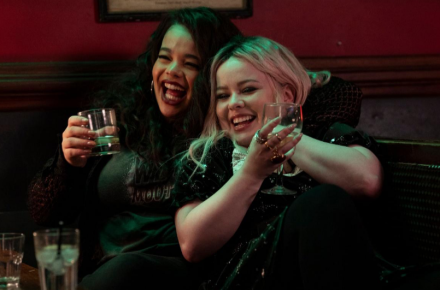
It’s been nearly a year since the chaotic events of Series One of Big Mood, and Eddie and Maggie haven’t spoken in all that time. As they re-enter each other’s lives, the series asks the question: can a friendship truly recover after a major falling out?
Maggie is a year into her recovery from lithium poisoning, and doing very sensible, un-Maggie-like activities to keep herself “stable” – something she’s desperate to be perceived as. But that hard-won stability is about to be seriously tested by Eddie re-entering her life.
As someone who would do anything to avoid dealing with her own internal battles, Eddie has been attempting a healing journey of her own: she’s formed an intense friendship with Whitney, a spiritual influencer from California. Has she truly found inner peace? Is her head in the sand, or is it lodged firmly up a crystal healer?
This series finds the comedy in Maggie and Eddie both living in denial, papering over the cracks in their fragile friendship.
Big Mood is written and created by Camilla Whitehill.
Big Mood Series Two starts on Thursday 16th April on C4 at 10pm.
Q&A with Nicola Coughlan who plays Maggie
Talk us through Maggie's journey in series two.
We left her at the end of series one really trying to get her life together, and I think it's a very relatable thing — we all try to be like, I'll be the new version of myself, I'll do yoga all the time, I'll drink green juice. But she comes up against the challenges within herself of trying to change her entire way of being, while also facing people being very sceptical that she can actually do any of it.
In series one, a lot of the story is about her dealing with the ups and downs of her bipolar disorder. This time she's in a more stable place, but she's looking at the things that have happened in her life because of it and trying to make good on them. The difficulty of changing your friends' perception of you is a huge thing, and she really struggles with that. She's battling within herself and within her family and friendships all at once.
I understand Camilla wrote the role of Maggie specifically with you in mind. How did that come about?
It's really funny, because we always joke that I never actually agreed to do it. We've known each other for such a long time — seventeen years this year, which is nuts to me. We met at drama school. She started out as an actor, and then when she started writing short plays I was like, oh my God, she is amazingly talented. So I always wanted to work with her, and I had no doubt in my mind about that.
And Maggie is such a great character to get to play, because she doesn't worry about being likeable at all. I'd love to say I'm completely unburdened by other people's opinions, but that's just not true — so it's quite refreshing to play someone who truly is. She really only cares, for better or worse, what Eddie thinks of her. She can quite easily cut everyone else out, I think.
The show treats bipolar disorder with real nuance — it’s both funny and serious in equal measure. How did you find that balance so it never felt trivialised or too heavy?
I think a lot of that's in the writing. We were never making an issues-based show — it's like Maggie happens to have bipolar disorder. It affects her life, but it isn't deep down who she is. We always felt like we were leading with the story of their friendship, and this is something that gets in the way of it. I think anxiety and depression are quite palatable topics now, but when you get into bipolar disorder or schizophrenia, people get a lot more uncomfortable. Those conversations about how it can make things difficult for your friends and family, how it's not straightforward to manage — that's still quite taboo.
But the writing explores it in such an honest way. And this series you really see Maggie trying to do her best, which is a very difficult thing. Medicating bipolar disorder is infamously hard because it's about striking a balance — it's not like you're depressed and put on uppers. It's a very tricky balance that people can struggle for years to get right.
What did you recognise from your own friendships in Maggie and Eddie's relationship?
That dynamic of the roles you assign one another when you first meet — it's really hard to escape them. Like, I'm the youngest in my family, and it's always hard to be seen as anything other than the baby. Friendships can be the same — whatever is imprinted early on is still there somehow. It's hard to outgrow it and say, hey, I'm not this anymore. You have to prove it with your actions. And how imperfect we all are — your heart bleeds for Maggie because she's trying to do her best, but it just so often goes horribly wrong.
The accountability of growing and changing, but staying together — that's what true friendships and relationships are. You have to expect change. There are certain points where the jigsaw pieces don't fit as well together, but it doesn't mean they won't come back together in the end.
The chemistry between you and Lydia West, who Eddie, plays is so central to the show. How did you build that sense of history between Maggie and Eddie?
I'm genuinely lucky that I really adore Lydia. She's a lovely person to work with and spend time with — very grounded in the real world, which is always just a lovely thing. She's generous not just with her time but with her energy, with everything. She's very real. I think anyone that meets Lydia will tell you she's a very easy person to like and to spend time with. So it was no hard work on my end, because she's just a doll.
What do you hope audiences will most enjoy about Big Mood series two?
You always hope that people will see themselves in it and feel reflected — see their friendships in it and think, it's okay that my friendship with so-and-so isn't perfect right now. It's just going through a stage of life. And also to open up conversations about the difficulties of mental health — to go, this can make you kind of a bad friend sometimes, but that's okay. I'm still here. All of that stuff. But also you just want people to feel things. You want them to laugh and to cry. That's the only reason you ever really make anything.
Without giving too much away, what surprised you most about Maggie this series?
What I found really lovely is that she grows to have more self-acceptance — for who she is, for the things she can't control and the things she can. She finds a lot of strength in that. She grows up massively, and it's not without growing pains, but by the end you get this sense that actually she’s going to be okay. She's going to be doing well.
Interview/picture supplied by publicists


